February 19th, 2014

Last month, Dr. Peterson turned the big 5-0! Rather than have a typical office birthday, we did something really special!

We pretended the day would be a normal day of patients and filled the calendar up with fake patient names, like Noah and Allie Calhoun. We decorated the office and had matching shirts made for the occasion that said, "I'm with the old guy" and for Dr. Peterson, "I am the old guy"!

We surprised Dr. Peterson with a trip to I Fly for some indoor skydiving and afterwards we got lunch at The Cheesecake Factory!
It was a great day and we hope he enjoyed his birthday!

February 18th, 2014
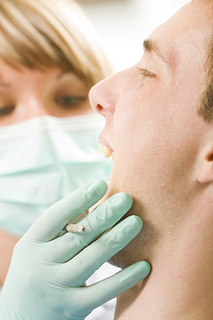
Oral cancer is largely viewed as a disease that affects those over the age of 40, but it can affect all ages, even non-tobacco and alcohol users. Oral cancer can occur on the lips, gums, tongue, inside lining of the cheeks, roof of the mouth, and the floor of the mouth. Our team at Northwest Smile Design recently put together some facts and figures to illustrate the importance of visiting our Marysville, WA office.
Our friends at the American Cancer Society recommend an oral cancer screening exam every three years for people over the age of 20 and annually for those over age 40. Because early detection can improve the chance of successful treatment, be sure to ask Dr. Kelly Peterson and our team to conduct an oral exam during your next visit to our Marysville, WA office.
- Symptoms of oral cancer may include a sore in the throat or mouth that bleeds easily and does not heal, a red or white patch that persists, a lump or thickening, ear pain, a neck mass, or coughing up blood. Difficulties in chewing, swallowing, or moving the tongue or jaws are often late symptoms.
- The primary risk factors for oral cancer in American men and women are tobacco (including smokeless tobacco) and alcohol use. Risk rises dramatically (30%) for people who both smoke and consume alcohol regularly.
- Oral cancers are part of a group of cancers commonly referred to as head and neck cancers, and of all head and neck cancers they comprise about 85% of that category.
- Oral cancer is the sixth most common cancer among men.
- Oral cancer is more likely to affect people over 40 years of age, though an increasing number of young people are developing the condition.
- Death rates have been decreasing over the past three decades; from 2004 to 2008, rates decreased by 1.2% per year in men and by 2.2% per year in women, according to the American Cancer Society.
- About 75% to 80% of people with oral cavity and pharynx cancer consume alcohol.
- The risk of developing oral cavity and pharynx cancers increases both with the amount as well as the length of time tobacco and alcohol products are used.
- For all stages combined, about 84% of people with oral cancer survive one year after diagnosis. The five- and ten-year relative survival rates are 61% and 50%, respectively.
- It is estimated that approximately $3.2 billion is spent in the United States annually on treatment of head and neck cancers.
Cancer can affect any part of the oral cavity, including the lip, tongue, mouth, and throat. Through visual inspection, Dr. Kelly Peterson and our team at Northwest Smile Design can often detect premalignant abnormalities and cancer at an early stage, when treatment is both less extensive and more successful.
Please let us now if you have any questions about your oral health either during your next scheduled appointment, by giving us a call or asking us on Facebook.
February 11th, 2014

From a student handing out sweets for her classmates to an older married couple exchanging boxes of candy, Valentine’s Day is the time of year when people like to show affection by gifting sugary treats to their loved ones. Whether you’re on the giving or receiving end of Valentine’s Day candy, you can celebrate the holiday in a healthier way by making dark chocolate your confection of choice.
Contribute to Your Health
According to the Cleveland Clinic, studies have shown that the cocoa beans used to make chocolate contain flavonoids, which can help protect the body against damage from various toxins. Flavonoids may also help lower blood pressure and improve blood flow to the heart and the brain. Dark chocolates typically contain a higher amount of flavonoids than other types, making them a great choice for chocolate lovers. However, you should keep in mind that many companies produce chocolate that is so heavily processed that the flavonoids are largely eliminated. Your best bet is to look for high-quality dark chocolates and cocoa powders that have undergone minimal processing.
Protect Against Cavities
If you think there’s no way candy could ever be beneficial for your teeth, think again. The Texas A&M Health Science Center has reported that the tannins present in cocoa beans may actually help prevent cavities by interfering with bacteria’s harmful interaction with teeth. Just like with flavonoids, tannins have been found to be present more often in dark chocolates, rather than milk chocolates, giving you another great reason to choose the richer, sweet varieties.
Avoid a Sticky Situation
One more benefit of choosing chocolate over other candies is that it is less likely to get stuck in the crevices and spaces between teeth. Gooey sweets like taffy can stay lodged in the mouth for longer periods of time, putting you at a greater risk for developing cavities. When you choose your chocolate, be sure to avoid types that also contain sticky ingredients like caramel or marshmallow, and instead opt for the plain varieties.
Remember that the health benefits you can receive from dark chocolate are largely based on eating the candy in moderation. With that being said, it’s easy to make this delicious and health conscious switch when you’re out shopping for your sweetheart, friends, loved ones, and yourself. Have fun satisfying your sweet tooth this year and Happy Valentine’s Day from all of us at Northwest Smile Design!
February 4th, 2014

The American Academy of Periodontology stresses the importance of good oral health since gum disease may be linked to heart disease and stroke. Thus far, no cause-and-effect relationship has been established, but there are multiple theories to explain the link between heart disease and periodontal disease. One theory suggests that oral bacteria may affect heart health when it enters the blood and attaches to the fatty plaque in the heart's blood vessels. This can cause the formation of blood clots. Another theory suggests the possibility that inflammation could be a contributing link between periodontal disease and heart disease. Gum disease increases plaque buildup, and inflamed gums may also contribute to the development of swollen or inflamed coronary arteries.
What is coronary artery disease?
Coronary artery disease is caused in part by the buildup of fatty proteins on the walls of the coronary arteries. Blood clots cut off blood flow, preventing oxygen and nutrients from getting to the heart. Both blood clots and the buildup of fatty proteins (also called plaque) on the walls of the coronary arteries may lead to a heart attack. Moreover, periodontal disease nearly doubles the likelihood that someone will suffer from coronary artery disease. Periodontal disease can also worsen existing heart conditions, so many patients who suffer from heart disease need to take antibiotics before any dental procedures. This is especially true of patients who are at greatest risk for contracting infective endocarditis (inflammation of the inner layer of the heart). The fact that more than 2,400 people die from heart disease each day makes it a major public health issue. It is also the leading killer of both men and women in the United States today.
What is periodontal disease?
Periodontal disease is a chronic inflammatory disease that destroys the bone and gum tissues around the teeth, reducing or potentially eradicating the system that supports your teeth. It affects roughly 75 percent of Americans, and is the leading cause of adult tooth loss. People who suffer from periodontal disease may notice that their gums swell and/or bleed when they brush their teeth.
Although there is no definitive proof to support the theory that oral bacteria affects the heart, it is widely acknowledged better oral health contributes to overall better health. When people take good care of their teeth, get thorough exams, and a professional cleaning twice a year, the buildup of plaque on the teeth is lessened. A healthy, well-balanced diet will also contribute to better oral and heart health. There is a lot of truth to the saying "you are what you eat." If you have any questions about you periodontal disease and your overall health, give our Marysville, WA office a call!









 Website Powered by Sesame 24-7™